
On July 3, 2024, Japan’s Supreme Court ruled that the Eugenic Protection Law. which had been in force from 1948 to 1996. was unconstitutional. The law had authorized the forced sterilization of people with disabilities, mental illnesses, hereditary disorders, and leprosy to prevent the birth of “inferior descendants.” The court ordered the government to pay compensation. It was a landmark ruling that was 76 years too late.
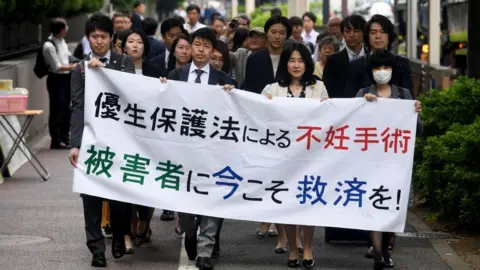
Image 1: Demonstrators march in support of forced sterilisation victims in 2018 (getty image)
Under the Eugenic Protection law, an estimated 25,000 people were forcibly sterilized and nearly 60,000 women were forced to have abortions. The vast majority were disabled women. Many were children. The youngest documented victim was nine years old. One survivor, Junko Lizuka, was sterilized at the age of 16, without knowing it. She stated, “was sterilized at the age of 16 without knowing it. I demand an apology from the state that forced me to undergo the procedure and continue to raise my voice.” Another survivor, Yumi Suzuki, was 12 years old when she was taken to a hospital without explanation and sterilized against her will.
This is not a distant historical atrocity. The law was in force until 1996. People alive today were sterilized under it as recently as 28 years ago. The Japanese government maintained for decades that the sterilizations were legal at the time and resisted accountability until survivors and their advocates forced the issue through years of litigation.
What the law said and what it did
From 1948 to 1996, the Eugenic Protection law allowed authorities to forcibly sterilize people with disabilities, including those with mental disorders, hereditary diseases or physical deformities, and leprosy. It also allowed forced abortion if either parent had those conditions. The law’s stated purpose was “”to prevent the increase of inferior descendants from the eugenic point of view and to protect the life and health of the mother.” Among the conditions mentioned as necessitating sterilization were “remarkable abnormal sexual desire” and “remarkable criminal inclination.”
The law was modeled in part on Nazi Germany’s eugenics program. Germany and Sweden, who implemented similar measures, apologized and provided compensation to survivors decades earlier. Japan did not formally acknowledge the harm until 2019, when the parliament approved the first compensation law, which gave each victim a one-time payment of 3.2 million yen, or nearly $21,000 to each survivor. The amount was criticized as inadequate. Following the Supreme Court’s 2024 ruling, a new Compensation Act came into force in January 2025, requiring payouts of 15 million yen to victims of forced surgery, 5 million yen to their spouses, and 2 million yen to women forced to have abortions

Image 2:Junko lizuka addresses a forum at the Tohoku Gakuin University in Sendai, Japan. Photograph: Daniel Hurst/The Guardian
This is the medical incarceration framework
At CripJustice, we define medical incarceration as involuntary or non-consensual detainment, including psychiatric hospitalization, the use of solitary confinement for medical or mental health reasons, and the use of state medical authority to confine or control disabled bodies without consent. Japan’s Eugenic Protection Law is medical incarceration by a different name. It used the authority of the state and the medical establishment to perform irreversible procedures on disabled people without their knowledge or consent, to eliminate their reproductive capacity and treat their bodies as a problem to be solved rather than a life to be lived.
The word the law used was eugenics. The word for what eugenics does to bodies is disability production and disability elimination through state violence. The people sterilized under this law were disabled. Their disability was treated as the justification for denying them the most fundamental form of bodily autonomy: the right to decide whether and when to have children.
The connection to reproductive justice
CripJustice’s framework recognizes reproductive rights as an intersecting issue. The forced sterilization of disabled women is one of the oldest and most sustained forms of reproductive violence in modern history. It is not unique to Japan. The US sterilized tens of thousands of disabled people under eugenics law, a practice the Supreme Court upheld in the 1927 Buck v. Bell decision, which has never been formally overturned. California sterilized more people than any other state and continued the practice in its prisons as recently as 2010. Germany, Sweden, Canada, and dozens of other countries had similar programs.
The disability justice movement has long argued that reproductive justice is inseparable from disability justice: the right to have children, and the right to parent your children are all bodily autonomy issues that disabled people have been systematically denied. Japan’s Supreme Court ruling is a legal acknowledgment of that violation. The compensation that follows is a partial and inadequate repair.

What accountability actually looks like
Following the Supreme Court ruling, the Japanese government established an Action Plan Against Ableism in December 2024 and commissioned a third-party investigation into the cause of the forced sterilizations, the extent of harm, and why the law remained in place for 48 years without being properly revised. That investigation is ongoing.
On July 17, 2024, former Prime Minister Kishida personally apologixzed to survivors in the Prime Minister’s Office, and the former Justice Minister also issued a formal apology. Parliament’s compensation law contains a formal apology stating, “We sincerely and deeply apologise for promoting erroneous policies based on eugenics.”
These are meaningful steps. They are also the minimum. The people who were sterilized at nine, twelve, fifteen, sixteen years old did not receive an apology for most of their lives. Many people have died without receiving acknowledgment at all. While the current settlement is greater than the 2019 payout, it is not enough to replace what was taken.
What this means for us
At CripJustice, we name the systems that remove bodily autonomy from disabled people and call it care, treatment, or protection. Japan’s Eugenic Protection Law is one of the most explicit examples of that logic in modern history: a law that said, in writing, that disabled people’s descendants were inferior and that the state had the right to prevent their birth through forced surgery on children.
That law was in force until 1996. The survivors who are still alive are not ancient history. They are people in their fifties, sixties, seventies, and eighties who spent their entire adult lives knowing what was done to them and being told it was legal. The Supreme Court has now said it was not. That matters. So does the 76-year gap between when it started and when accountability came.
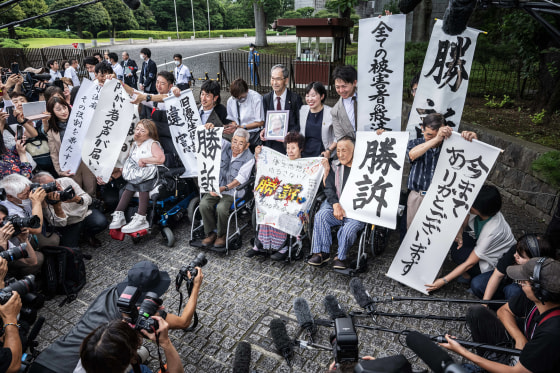
Image 4:Victims of forced sterilization under a now-defunct eugenics law celebrating outside Japan’s Supreme Court in Tokyo on Wednesday.Yuichi Yamazaki / AFP – Getty Images
Sources
New compensation law for former Eugenic Protection Act victims — DPI Japan, October 23, 2024
Japan’s top court rules forced sterilisation law unconstitutional — Gulf News, July 3, 2024
Forced sterilisation victims to receive compensation — ICLG, February 2025

